
Why Kriya separates the editor from the runtime
A visual editor should help you build the game without becoming a dependency of the game you ship.
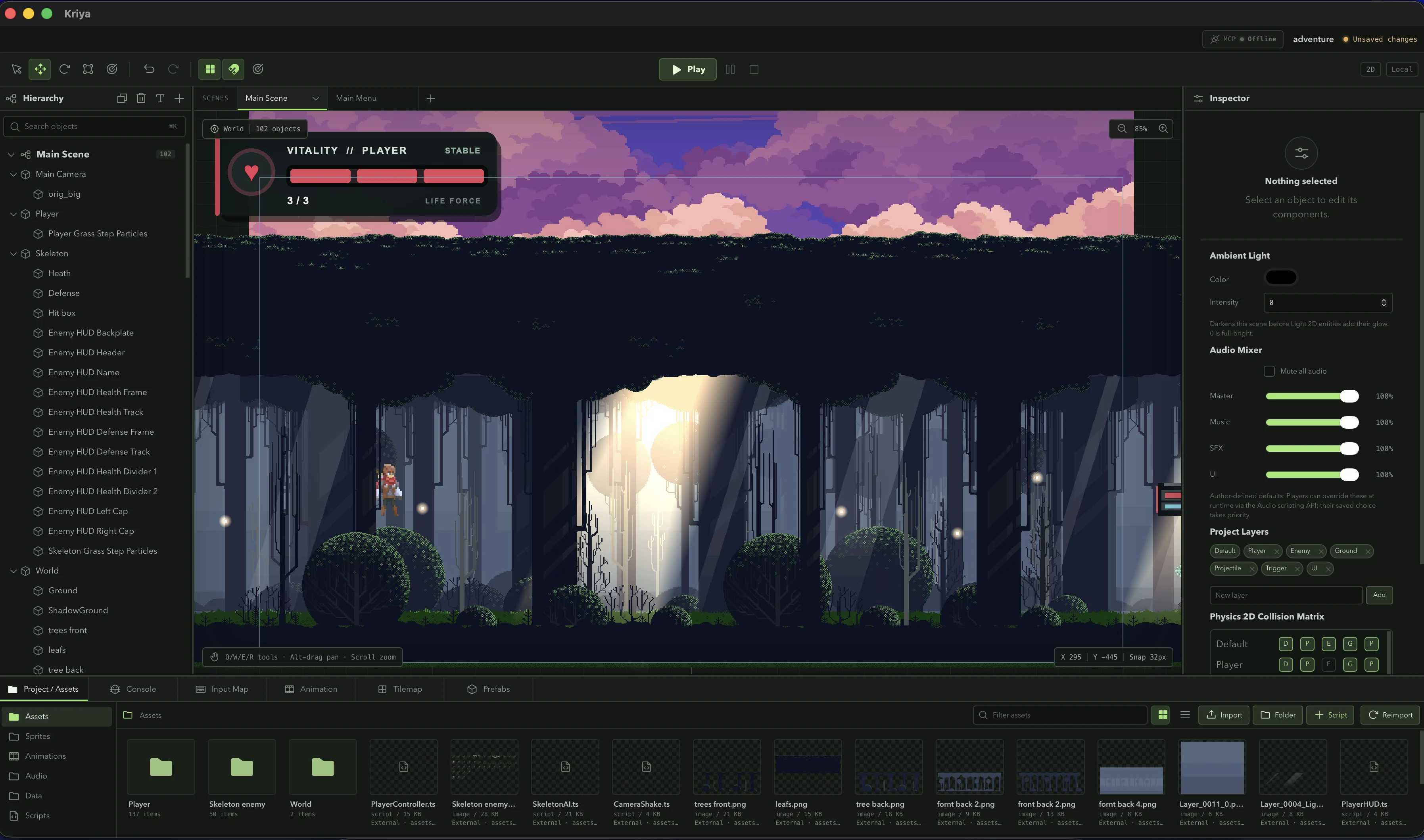
The editor and the game have different jobs. The editor needs panels, selection state, inspectors, asset tools, and a safe place to iterate. The runtime needs to load a project, update its systems, render frames, and stay predictable on the target device.
Kriya treats those as two parts of one workflow instead of one inseparable application.
The project is the contract
A Kriya scene is stored as project data. The editor changes that data through visual tools, while the runtime consumes it to create entities, components, scripts, physics bodies, input bindings, and animation state.
That boundary matters. Gameplay does not need to know which inspector field was open when the project was saved, and the editor does not need to be bundled into a web export.
The result is a shorter path through the system:
- Author a scene in the editor.
- Preview it with the Kriya runtime.
- Export the project and the runtime needed by the target platform.
One runtime from preview to export
Previewing with the same runtime model used by exports removes a frustrating class of surprises. Movement, physics, animation events, input actions, and script lifecycle behavior should not change just because the game moved out of the editor window.
Kriya’s runtime owns the game loop and advances gameplay through clear stages, including script updates and a fixed physics step. The editor remains the authoring surface around that loop.
A smaller shipped surface
Keeping the boundary explicit also makes the exported game easier to reason about. Editor-only UI, authoring state, and desktop integration are not part of the gameplay contract. A web build gets a focused player; a desktop or Android build gets the platform wrapper it needs.
This is not separation for its own sake. It is what lets a visual workflow stay comfortable while the final game remains portable.
Where this leads
The same project boundary supports more than export. It also gives tooling a structured way to inspect the active game. Kriya’s MCP integration can work with scenes, entities, assets, scripts, and builds without treating the editor screen as an opaque collection of pixels.
The editor stays visual. The runtime stays focused. The project keeps them in agreement.