
Giving AI agents structured access to a game project
Why Kriya uses MCP to let an agent understand scenes and scripts instead of guessing from screenshots.
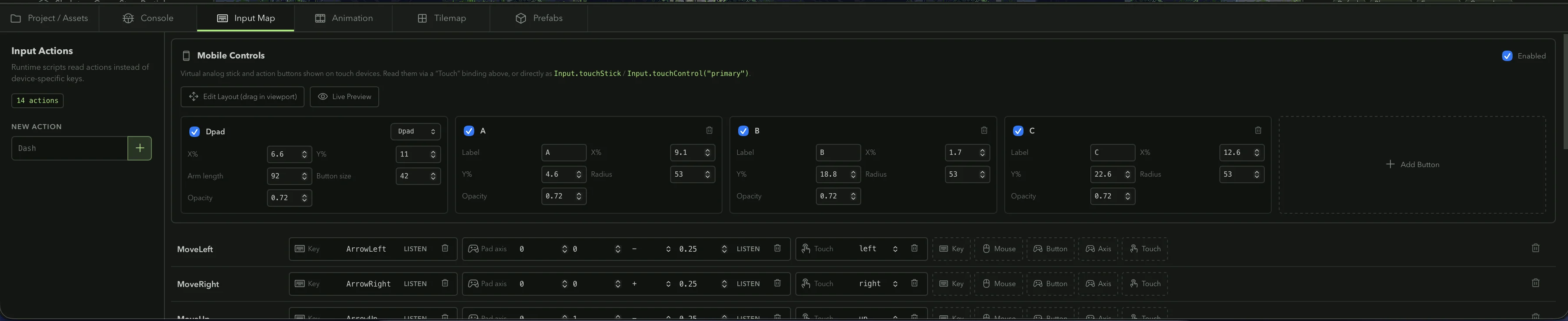
An AI agent is most useful when it can understand the same structure the engine understands. A screenshot can show that an editor contains a scene, but it cannot reliably explain which entity owns a collider, where an input action is stored, or which script is attached to the player.
Kriya uses the Model Context Protocol (MCP) to expose that structure directly.
Context before changes
Through Kriya’s desktop MCP server, a compatible agent can inspect the active project as scenes, entities, components, assets, scripts, input actions, animations, prefabs, and build settings.
Resources such as kriya://project and kriya://scripting-api give the agent both project context and the public API available to gameplay scripts. That makes a request like “add a patrol behavior” concrete: the agent can first find the enemy entity, inspect its current components, and write against APIs the engine actually supports.
Tools with engine-level intent
Structured tools are more reliable than simulating a sequence of clicks. An agent can make a scoped change, receive diagnostics, and verify the resulting project model. The editor remains the place where the developer sees and refines the result.
A useful agent workflow looks like this:
- Read the active project and relevant scripting APIs.
- Locate the entities, assets, and input actions involved.
- Apply a focused project or script change.
- Inspect diagnostics and preview the result.
- Run the existing export pipeline when the project is ready.
Live means the open project
MCP setup is generated from the desktop editor and added once to the client. When MCP Live is enabled, synchronization follows the project currently open in Kriya.
That detail keeps the relationship understandable: the agent and the developer are working against the same active project, while Kriya remains the source of truth for project structure and validation.
An assistant, not a second engine
The agent does not invent a private representation of the game. It works through the same concepts used by the editor and runtime. Developers can ask for broad help, then inspect the exact entities, scripts, and settings that changed.
This is the direction Kriya is pushing: keep game creation visual, make engine context machine-readable, and let an AI agent take on repetitive implementation without obscuring the project it leaves behind.